This paper focuses the relationship between Telecom Operators and Research Networks in Developing Countries. The concept of a mutual benefit relationship is presented as a desirable objective. Telecom Operators would benefit from the Research Networks in terms of creation of the data communication and value-added networks markets, as well as in the transfer of technical know-how in the field of networks. The Research Networks would benefit from the Telecom Operators services, primarily with the access to high speed dedicated lines, which represent a large proportion of their expenses. Such synergetic relationship would furthermore represent a benefit for the development of the country. The reasons why negotiation between the two partners is a valuable approach are presented. Some guidelines are shown for the Research Network to direct an efficient negotiation process. A set of arguments are listed for the Telecom Operators to make them confident this is a correct way to pursue, business wise. The paper refers to corresponding ITU/UNESCO recommendations and to the Dominican Republic Research Network experience (REDID, one of the REDALC projects) which served as a prototype for this approach.
The key importance of Telecommunications for development have already been shown (see for instance "Telecommunications and Economic Development", by R.J. Saunders and al, A World Bank Publication, Johns Hopkins, 1983). For different reasons, Science and Technology, is another well identified development asset. Besides their importance for the development of a country, both areas are vital for its independence.
At the time when the technologies and markets of telecommunications, computers and media are merging to create the most important challenge/opportunity for the world development, namely the information infrastructure (or "infostructure"), careful attention should be paid, in the South, to create a synergetic relationship between the Research world and the Telecommunications industries. This is a matter which goes beyond the direct interests of the two groups: it will serve as the basis for appropriate research and development as well as technology transfer, from domestic knowledge and lessons learned abroad. A new form of flexible collaborative research is developing using networks, where research is deployed to actual use with feedback changing both research agendas and use. As a vehicle for research collaboration and distance education, for all sectors, it will build human resources and institutional capacity. The relationship between telecom operators and research networks is, in the developing countries, a perfect opportunity to start trying this new model.
The tariff advantages which could be obtained in such relationship should not be considered as a form of subsidizing (which would come into contradiction with the global liberalizing movement which is on the way in the Telecommunication industry), but rather treated for what it is really: a balanced economic exchange, since there are clear business reasons for the Telecom players to participate in a partnership which both strengthen domestic capacity and the demand for telecom services.
In one side, the cost of international and national communications still represents the most important item in a national Research Network budget and very often the principal difficulty for the growth of these networks in the South. In the other side, in most of the developing countries, the data communication and value-added network markets are slow to emerge and the chicken and egg syndrome between users and services could not be cut easily with classical marketing tectonics.
In the other side, the Research Networks have formed, almost everywhere, the initial base of users for the value-added services, developing a valuable expertise in terms of user marketing and support, data communication technology and information providing. The Telecom Operators are the providers and set the tariff patterns for the use of the data transmission facilities. The terms of supply will cultivate or restrain usage depending on costs.
This actual situation and the practical possibility of a balanced exchange implies a unique opportunity for the creation of partner-type relationships which benefits to both entities and, eventually, the whole country's development.
Looking at the trends for the future of the telecommunication market (in terms of the relative importance of voice and data, and also of information providing vs. data transportation), acknowledging the importance of the role of the research community in shaping the tools and the culture of the information society, the Telecom Operators should understand that partnership with the research people could be a valuable investment for the medium and long term range. In some specific cases, the Telecom Operator may be very sensitive to the short term and then reluctant to loose immediate revenues from that particular market segment, in spite of the expected medium term return of investment. In those cases, they should then perceive the opportunity for a risk-venture where the investment is extremely marginal and where the potential long term benefits could be of major importance. The telecommunications markets are changing too fast and too deeply to justify attitudes with arguments from the past1.
This paper pretends, generalizing the successful results of one of the REDALC projects2, to conceptualize a framework for negotiation between Research Networks and Telecom Operators based on the concept of mutual respect and mutual benefit.3
The foundation of the strategy is that:
There is an area
of common interest between
the Telecom Operators and the Research Networks:
the development and growth of a base of users.
Both groups are interested in the growth of the propensity of the citizens and professionals to become fluent users of the New Information and Communication Technologies. One for obvious business reasons. The other one because its vocation is to help the maximum number of researchers in their way to the professional benefits of becoming satisfied and skilled network users. Also, because the most empowered research users from the South, the strongest will be this group to represent and defend the global interests of the South in the emergence of the New Information Society4.
The Research Network people presents, for the Telecom Operators, the following unique advantages:
-They represent a subset of their customer base which is of marginal importance for direct revenues and high influence for indirect revenues.
-Most often they represent a data communication, networks and information global know-how which could usefully complement what exists within their own structure.
-They are provider of attractive and low-priced information.
-They are not competitors and never should be.
Marginal importance for direct revenues.
The total market for value-added services can be split several ways, one is into professional and residence markets (the mass market, which is, in terms of volume, the more important). If one focus only the professional market (the companies, whether micro, small, medium or large, and whether governmental, profit oriented or not), then, in terms of percentage of companies/institutions, the sum of the universities and the NGOs related to research represents a figure in the order of magnitude of 1 %. This is marginal for the potential revenues from telecommunication services (although one could be mislead by short term facts since they have been, traditionally, the first market segment to learn how to use the services5).
High influence for indirect revenues
However, the researchers represent a unique and very strong influence upon the market. First, because they teach the future executives, and, second, since most of them represents an example for private companies in terms of capacity for dealing with technology. Furthermore, in most of the countries of the South, economical circumstances drive the researchers to create their own structure (business or NGOs) and to involve them more tightly to the business environment. Last but not least, as non-profit information sites multiply, from research, academic and public sources, the commercial users are accessing them: this benefits business, development and telecom revenues.
No systematic survey and analysis have been made; however the point which is made is intuitively understandable. If one could scientifically measure the correlation between the buying decision of a customer and various parameters such as:
-influence of another user,
-suggestion by advertisement,
-suggestion by personal reading,
the first one would be the higher score in the case of information technology6. Of course, the recent mediatization phenomenon of the Internet call for a new and very important parameter the "fashion effect", but this one does not necessarily generates fully satisfied users since an account on the net is not the same thing as active and beneficial network use.
Network technology know-how
The know-how acquired by the community of on-line researchers is well demonstrated and has been translated in an impressive mass of freeware which would represent a serious business share if it had been marketed. The advance of this group in term of creativity for shaping the future of the information highway should not be underestimated. Within this group, in every country observed (from the North as well as from the South), one can find:
-the early networks technicians (and in particular, the builders of the software which have sustained the growth of the services),
-the early networks users,
-the early information providers.
Provider of valuable information
The researchers are the builder of the first free information base. This asset, originally dedicated to researchers, is equally attractive to professionals and may arise the interest of some casual users. The new commercial players in the Internet are building their information providing above the sound foundation which have been set up by the research community. In the regions where the cost of data communication weight high in budgets, the professional customers, after their first experiences and excitements of graphic navigation, will learn to measure the ratio real information/volume and to appreciate a content based search produced free by the academic world to fill their information requirements in the minimum time/cost investment.
Not competitors.
The vocation of Research Networks is to facilitate the access to the network services to the researcher community, and not to sale services to the whole market. Although, given local circumstances (like the absence of commercial offerings or extremely high data transmission price at any international standardas) and the decrease of international support, non profit oriented organizations may be pushed to more business-like practices in order to balance their finances, at cost recovery.
The situations where Research Networks have turned real competitors to Telecom Operators should progressively disappear:
-either because they will readily narrow their market to the original target, in exchange of special agreements for reducing the cost of their telecommunication infrastructure, and thus leave the room free for the commercial players;
-either because, if they pursue their objective of open marketing, they will be conducted to transform themselves into real business players and thus loose the characteristics of "Research" Networks (in that case their future could become very uncertain unless they assume themselves as full business entities and venture with capital business in order to compete).
In any case, the negotiation is the correct way to transform the situation without prejudice for both sides.
From the Research Network side
The first and obvious reason why a national Research Network should enter negotiation is to try to alleviate its telecommunication bill, the heavier part of its expenses. But they are more reasons, such as:
-to participate in the reinforcement of the national telecommunication and information infrastructures, participating positively in the democratic game;
-to involve both the university and the telecommunication players in the responsibility of educating the technicians which are necessary in that field;
-to nurture a capacity to properly use the technology to mutual benefit to all sectors of the country.
From the Telecom Operator side
The first argument is purely business. If the management looks beyond short term revenue maximization to long term market maximization, their are excellent reasons why it is wise to negotiate with the Research Network representatives. Indeed, it could be worthwhile, for the creation of the market, to consider, instead of expensive campaigns of advertisement, the attractively priced offering of accesses to that population. This in turn will indirectly create the demand from commercial users more efficiently than classical marketing. Furthermore, these skilled users would allow a free and efficient bench marking and beta testing of their services, giving another plus in the economical balance7.
There is another business reason. The national information infrastructure is usually slow to get organized in the South. Encouraging the research world to fulfill the initial requirements could help them to get a first level of national information basis, a necessary complement to arise the national users interests for getting the connectivity, but also, a primary element to open their market to the outside customers. This, additionally, will provide the local information sites for collaboration and development at the local level.
The last reason is that they could enhance their image as a development-minded player in the country.
The conditions exist for a mutual benefit relationship where:
-Research Networks indirectly help to the creation of the market place, both in terms of users and in terms of content.
-Telecom Operators facilitates the use of their infrastructure to help the growth of the Research Networks.
-Both sides can benefit of a transfer of technology from the other side.
To transform these conditions in real and effective partnerships, there are some requirements, which are simply the translation of effective management and mutual respect:
From the Research Network side:
-The responsible group of persons should lead the negotiation and learn to conduct it in a business style manner with the maximum perception of what is (generally and specifically) the "company culture" of the Telecom Operator.
-Rather than asking for special tariffs in the name of their usefulness for the nation development, they should use a language understandable by business oriented persons to demonstrate they are a key asset for the indirect growth of their revenue. It is not that the first argument is not valid, but they should reserve it for other partners (international organizations or representatives of the ministries of Education or Science and Technology). Of course, the Telecom Operators should, use this point in positive for their image when an agreement is obtained! But this is not the primarily reason for them to agree.
-By their actions and the coherence between the said and the done, they must gain the trust of the Telecom Operators and set the ground for a mature negotiation.
-If there is a worry, the statement "we are not a business contender" should be clearly stated and demonstrated in the facts. This must be understood as a passive as well as an active statement. Indeed, there is a room for passive business harm and non-profit networks must remain cautious against any efforts by their users to exploit preferential priced facilities for commercial gain.
The Telecom Operator maybe frightened by situations where institutional commitments are turned over by particulars and maybe doubtful of the capacity of the Research Network to control and prevent such occurrences. They must be treated very seriously since they represent both a harm for the business and a threat for the agreement. This question of boundary is particularly critical where the context is full of examples of lack of respect of legal matters (as for the software copyright). The correct reinforcement of Netiquette, especially in what it implies of possible threaten to the company business is one of the key pillar of the agreement, before, during and after the negotiation step. The Research Networks representatives must admit that it is not conceivable that they could at the same time argue they will help the market to emerge and close their eyes on users taking illegally away the expected revenues from their partner8!
From the Telecom Operator side:
-The Telecom Operator must clearly understand that the deal does not imply that the research people are going to market telecom services on their behalf. Nor that the Research Network (or its users) is obliged to an exclusive attitude, in terms of partnership. Individuals and organizations may have multiple service access needs and may deal with multiple service, equipment and software providers.
The independence of the research people from business matters must be respected and also their freedom to create multiple deals with companies in open competition. The last is clearly one of the most touchy issue in that negotiation and should be managed with the appropriate tact from the Research Network side. Here, the experience of EARN people in managing to get parallel support from the main computer industries leaders in the years 80's should be taken as model. Although, one should realize that the economical context in the South is not always mature enough and then room should be reserved for a progressive learning curve process. The stronger the Research Networks project themselves in terms of Netiquette, the stronger they will be in making the Telecom Operators accept them as non exclusive partners.
With a good relationship. this concern will fade as experience grows and as market expands, making the research network uses a small share of a growing user base. Their qualitative importance should not however be forgotten.
-The Research Networks people should emphasize, from the beginning, on approach based on medium and long terms results. They should try to identify, in the Telecom Operator structure, the persons who are functionally (and personally) the more capable to consider the business in the long term perspectives. Definitively, this will not be found in the market and sales group! Rather, depending on the size of the company and the dimension of the hierarchical line, they should negotiate with the staff of the top management or with the persons responsible for long term strategical marketing.
The perspective for successful negotiation are very different depending of three basic factors:
-the existence of a government-owned monopoly for telecommunications,
-the level of competition existing in that field,
-the level of maturity of the data communication market,
-the relative orientation/experience of the Telecom Operator towards data communication (in most of the case in the South, the voice traffic will represent the huge part of the revenues and short term data business have been so far a load for the Telecom Operators, generating more investments than revenues)9.
In principle, the best conditions are represented with a competitive field aiming at the creation of the data and value-added network market.
In the situation of strong monopoly and low propensity to negotiate directly with Research Networks, it could be wise to involve official representatives of Science and Technology or Education and let them negotiate on the Research Network behalf. Some case may occurs where the situation is totally blocked and the Telecom Operator representatives, immediate term oriented, are not even willing to recognize they are creating the conditions for a "by-pass" market. In those cases, some alternative tactical moves may be called for, such as satellite links or direct dial to other countries. In extreme situations, the practical solutions may turn into contradiction with the strategical guidelines offered; it should not be forgotten though they are tactical actions aiming at changing the objective conditions for the negotiation and that when this eventually occurs the role of a Research Network is definitively not to compete with the Telecom Operators.
-Coherence (within the various actions and between the said and the done) is one of the key criteria to measure the chances for success of the Research Network people in their relationship with Telecom Operators. If a firm and coherent attitude is maintained, the Research Network people will be in the situation to insure respect for their criteria, even in the most touchy area (the competition). If not, the credibility and trust will be lost. Without trust the negotiations will eventually fail. Coherence, besides being a necessary element to open negotiations, will be the key factor for subsequent deals with the same or other partners. Coherence will also be the fundamental ingredient for the strength to manage, in a balanced relationship, the tensions which could occur during the life of the agreement (for instance if the management changes in the Telecom Operator side and the new one has a very short term orientation and a propensity to forget the commitment).
-The reciprocal part of the coherence is the level of institutionalization: it is important to formalize the positive results of the negotiation in form of written agreement or contracts. This is the better protection of the stability of the agreements, their resistance against normal changes and the reinforcement of the level of institutionalization of the Research Network.
-Early involvement: Research network people should involved their potential partners from the early stage, this should help to create the conditions for fruitful and focused negotiations.
-Top management/ direct management: As in any well conducted negotiation, a balanced usage of management contacts should be handled. The involvement of top management is obviously required but should be reserved only for critical decisions. One should understand that a big company is not a monolithic complex. Obviously, within the management line, opponents will manifest themselves. The right strategy is to reinforce its position permanently with the direct partners and to consolidate with the top management (trying to formalize the agreement so that to be safe in case the direct contacts change their function assignment). In case of difficulties with the formal agreement, public presentation of the deal may represent another protection. The Research Network people may decide to write papers on the deal or refer to it in the Internet community, or, still better, try to get joined papers with their counterpart. Image is a very sensitive element for a company: never make public any information about the negotiation without official permission of your partner. This also means that the research network should have a representative structure with a clear mission statement.
-Managing the competitive situations: this could be the most difficult part of the art of negotiation. It has to be handled with an appropriate mixture of transparency (in the actions), firmness (in the principles) and flexibility (in the negotiation). The Research Networks should maintain a progressively growing pressure to defend their rights for multiple agreements, the pressure should be maintained always but obviously never pass the threshold of what the other side consider acceptable.
-Obtain a synergetic press campaign: A well negotiated agreement should include a promotional campaign from the Telecom Operator to sale its data service and referring to the deal with the research network. This would make the maximum synergy and allow a dual user marketing campaign where both sides would benefit in term of user growth10.
The future of the Information Society is wide open. In this area of very fast technological changes, the social and economical impact of the technology is still to come and difficult to predict, especially in the South where the Internet represents a complex mixture of challenges and opportunities. The recent emergence of a powerful commercial Internet adds to the complexity of the forecast pattern and to the risks side of its development in the South. Whatever are the scenarios of the growth of the Internet in the South, the need for a strong networking area in Science and Technology, capable to drive the creation of national and regional infostructures is clear. The path towards sustainable and active research networks requires the creation of new type of relationships between the various field actors, and primarily between the providers of telecommunications services facilities and the administrator of Research Networks.
1 ITU and Unesco organized a meeting in Geneva, Nov. 1993, for the "Economic Constraints to Effective Utilization of Telecommunications in Education, Science, Culture and the Circulation of Information". In the activity where representing persons from the "Unesco communities" (news, research and culture) and from Telecom. Operators (Tariff group) entered a open and frank dialog. Among the conclusion statements which will serve as reference for the ITU General Conference in Buenos Aires, in March 1994: "encourage partnership and joint-venture between Telecom. Operators and Unesco community user's". It was very interesting noticing than the persons the more reluctant to accept the argumentation during the meeting have in common belonging to a strong national telecommunication monopoly and focusing exclusively the voice market.
2 REDID have been operated since its birthday, in May 1992, thanks to the support of the company Codetel, a GTE subsidiary, which give a free of charge access to its UUCP e-mail facility and convey the research traffic to the Internet from and to the University of Puerto Rico, at its cost. The agreement have been formalized as a renewable one year contract defining the rights and obligations of each parties. Starting July 1995, a complementary venture associate REDID with the company AACR, where both will together create a body of trained students to sustain their respective plans for INTERNET services providing. AACR will within this agreement allow free use by REDID of its channel facilities.
3 Most of the concepts and considerations apply to other type of non-profit networks (such as networks of NGOs or freenets).
4 There is a growing understanding of the fact that networks will be important for efficient and effective r of civil society and the public sector. The time factor has become critical for what it at stakes, since the open evolution of the Internet towards a business media.
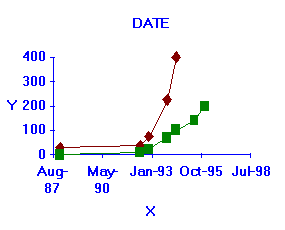
5 Indeed, in the case of REDID, with the deal, 20% of the customer of the commercial service went to the free market. However, they were not lost as customers for complementary services, and the growth of REDID, without any commercial campaign triggered the growth of the commercial service-the influence effect being extremely clear in the total number of user curves.
DATE |
.COM |
REDID |
01-88 |
30 |
0 |
06-92 |
40 |
10 |
12-92 |
75 |
25 |
12-93 |
225 |
75 |
06-94 |
400 |
110 |
In the case of the Haitian Network (REHRED) a deal was created with a private telecom company at the creation stage but unfortunately did not last. Our perception is that, beyond political reasons proper of this country, the special condition of the Haitian market makes the NGO's telecom usage such a huge proportion of the short term market that the private company stepped back. The result of the management decision will be measured in a larger time frame, when a research network will build its own infrastructure and the market start maturing.
6 In the caste study of REDID, after the first year of the agreement, REDID reached more customers than the commercial service (due to a more aggressive marketing) , but after the second year the coefficient of the commercial curve arise drastically, in spite of the lack of commercial campaign.
7 This is the release, response, revise model of service provision research which is more and more used by the big players of the software industry.
8 For instance, if a researcher is having an e.mail access by his/her condition and at the same time is managing a business, he/she must be informed that his/her business e.mail must be purchased in the commercial segment and that the use of the research e-mail for business is a serious offense to the by-laws of the Research Network implying legal action. In that very aspect, the experience has been totally positive in REDID, in spite the suspicion of some commercial agents of the Telecom Operator.
9 In the case of REDID, the early negotiation started in 1989, when the situation was of private monopoly. The deal was cut in 1992 when the entry of two private contenders provoke a fierce competition in the voice field (but the data field remained of very low attractiveness for the short term). Between, 1993 and 1994, complementary deals were made with AACR. In 1995, the conditions exist for the organization of complementary partnerships with each Telecom company. A possible framework would be that Codetel focus more particularly the Academic part, AACR the NGOs component and TRICOM the training of network technicians.
10 This is the only, but how frustrating, drawback REDID got with its deal with Codetel. The plan was set up for such campaign but for reasons remote from REDID will it never occurred. The occurrence of such action would have given a decisive impulse to the creation of the national e-mail market. Such matters does belong to the sphere of exclusive decision of the companies. Definitively, the history of networks would have been drastically different in that country would this campaign have happened.
This Web page was created using a Trial Version of HTML Transit 3.0.